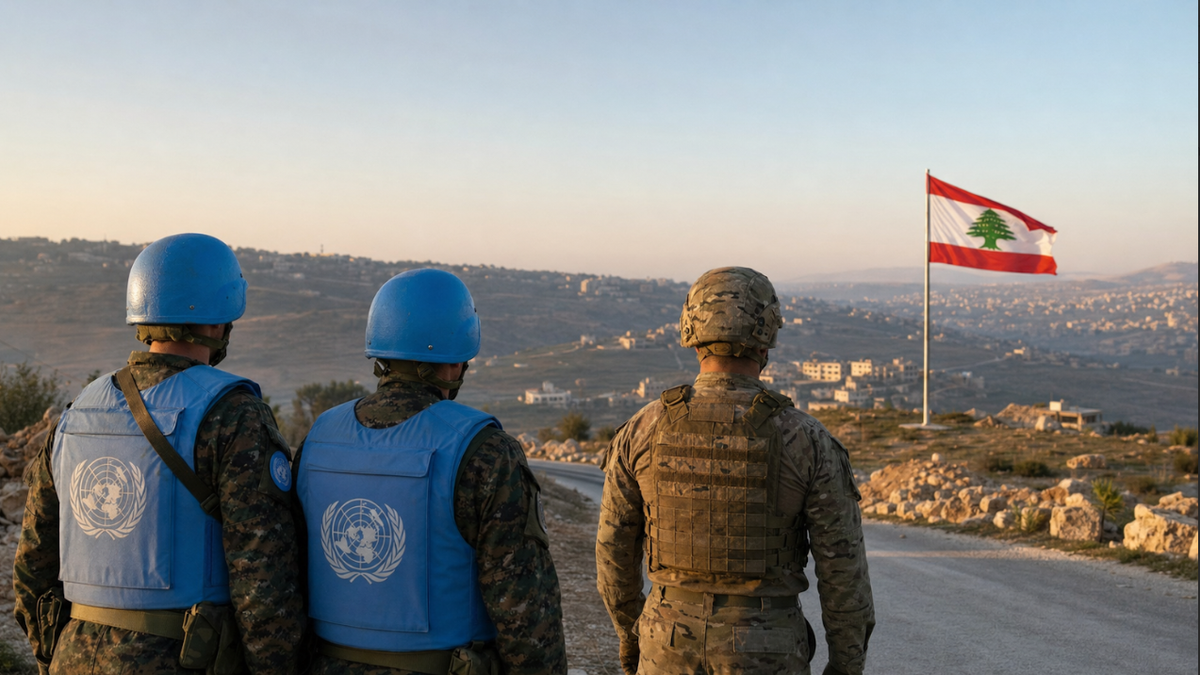
Lebanon has not yet decided what will follow UNIFIL.
Several possibilities remain under discussion, including reconsidering UNIFIL’s scheduled termination, another United Nations mission, a multinational force led by European states or a broader international arrangement. No formula has been adopted. That uncertainty is more than a security problem. It is a test of whether international support will consolidate Lebanese sovereignty in the south or continue compensating for its absence.
More than two thirds of Lebanon’s 128 MPs signed a joint letter to Security Council members calling for UNIFIL’s mandate to be extended. While not a formal parliamentary vote, it demonstrates shared concern about the consequences of UNIFIL’s departure.
The Lebanese Forces did not sign because they favor a different kind of international force after UNIFIL. Hezbollah, despite being directly concerned, has remained silent (Press Conference, 2026). The uncertainty has produced a debate about the identity, composition and mandate of a possible successor force. But the central question is twofold.
First, given the precarious and exceptional conditions in southern Lebanon, is a temporary international presence needed? If so, what precisely should its mandate, powers and duration be?
Second, is Lebanon prepared to trust the Lebanese Armed Forces (LAF), give them an unambiguous national mandate and ensure that the military command is willing and able to carry out the lawful orders of the state?
From One Force to Another UNIFIL was established in 1978 and substantially expanded after the 2006 war through Resolution 1701. For nearly five decades, UNIFIL has patrolled, observed, reported and helped contain escalation along one of the region’s most volatile frontiers. Those functions mattered but did not prevent militias from entrenching themselves or developing military infrastructure in the south.
UNIFIL personnel are peacekeepers, not Lebanon’s sovereign army. They cannot restore or enforce Lebanese sovereignty for the state (United Nations Security Council, 2006; UNIFIL, 2026).
In August 2025, the United Nations Security Council unanimously adopted Resolution 2790, extending UNIFIL’s mandate for a final time until 31 December 2026. The resolution provides for an orderly and safe drawdown and withdrawal beginning after that date and concluding within one year. Its stated objective is to make the Lebanese government “the sole provider of security in southern Lebanon.”
That phrase should define the discussion about what follows UNIFIL. The sole provider of security must be the Lebanese state, not Hezbollah, Israel or foreign troops (United Nations Security Council, 2025). UNIFIL’s departure was never intended to lead automatically to the permanent installation of another international force. The transition was meant to culminate in the Lebanese government assuming responsibility for its territory through the LAF. But the conditions for that transition are now far more precarious. Large areas of the south have been devastated, many people remain internally displaced, Hezbollah still retains weapons and military infrastructure, and parts of the territory remain under Israeli occupation.
The LAF may therefore require substantial support to assume all the responsibilities currently shared with UNIFIL (United Nations, 2026a, 2026b; United Nations Security Council, 2025). Supporters of extending UNIFIL’s mandate or replacing it with another international force warn that its departure could create a security vacuum. That concern is valid. Without an effective transitional arrangement, the gap between UNIFIL’s withdrawal and the army’s ability to assume full control could deepen instability.
These circumstances have led much of the debate to assume that one foreign mission must be replaced by another. If Lebanon chooses that path, it should first ask what precisely a new force would be expected to do. Its mandate cannot be vague. Would the force merely monitor violations, or would it possess enforcement powers? Would it operate independently or alongside the LAF? Could it inspect suspected weapons depots and tunnels controlled by armed groups? To whom would it answer? How would its conduct be reviewed, and when would its mission end? These are not technical details. They are the substance of the debate. A successor force operating under essentially the same restrictions as UNIFIL could reproduce the same arrangement under a different name, helping to contain the consequences without resolving the cause. But a force with significantly broader powers could have serious constitutional, political and security implications.
Whatever formula is adopted, any successor arrangement must be designed to enable the LAF to assume full responsibility within a short and clearly defined transition period. The LAF is the only legitimate national military institution capable of assuming responsibility for security in the south and throughout the country. But trust in the army cannot remain rhetorical. The government must provide adequate resources, sustained financial support, personnel and equipment. However, material support alone is insufficient. More importantly, the government must grant the army clear operational authority and protect it from political interference, pressure and obstruction. The decisive requirement is political will.
For years, Lebanese leaders have declared their support for the army while denying it the full authority to act as the country’s exclusive military institution. The government must issue clear and lawful orders. The army’s command must then have the determination to implement them. Its commander must be prepared to exercise the institution’s powers, enforce its chain of command and carry out the mission entrusted to the army.
The issue, therefore, is not simply whether the LAF currently possesses sufficient military capability. Lebanon and its international partners can address shortfalls in financing, equipment, mobility, surveillance and engineering capacity. The deeper question is whether the state will give the army a single mission, one chain of command and the political protection required to fulfil it.
The Framework already Points to the LAF The recent framework brokered by the United States between Lebanon and Israel explicitly places the LAF at the center of the transition. It states that “the LAF will restore effective sovereign authority over all Lebanese territory” as armed groups outside state control are disarmed and Israeli forces progressively withdraw. Lebanon and Israel also “commit to establishing a military coordination group” with the support and participation of the United States to oversee implementation (US Department of State, 2026). The framework has moved one step closer to implementation.
Following two days of talks mediated by the United States in Rome, the parties agreed on the structure and guidelines for the process involving two initial pilot zones. These arrangements are to be finalized and implemented in the coming days. Within those zones, the process is intended to facilitate Israeli withdrawal and the extension of LAF control (US Embassy in Beirut, 2026). The framework identifies the LAF as the principal institution responsible for the transition. The objective should be unequivocal. Southern Lebanon must no longer be controlled by Hezbollah, occupied by Israel or indefinitely administered by international peacekeepers. It must be secured by the Lebanese state through the LAF. This does not mean rejecting international assistance. Lebanon will continue to require strong external support to finance and equip the LAF, provide training and technical expertise, and help stabilize the communities to which displaced Lebanese must return.
A temporary international force may be necessary under the present circumstances, but its mandate must be clearly defined, its duration limited and its success measured by the responsibility it transfers to the LAF.