Stay informed. Provide your contact details to join our mailing list.
Exploiting the Commons: Hezbollah’s Systematic Weaponization of Lebanon's Civilian and Cultural Infrastructure.
★★★★★★
ALEF Team
Published
June 2, 2026
The core of Hezbollah’s military methodology relies on a calculated doctrine: the mobilization of all civilian, educational, welfare, and healthcare systems to support its armed apparatus. By embedding military architecture within protected spaces, the militia cynically exploits international humanitarian law to shield its assets, complicate enemy targeting, and manage a sophisticated propaganda narrative when those spaces are inevitably struck.
Verified field disclosures and recorded operational data have exposed a definitive pattern of Hezbollah weaponizing Lebanon's protected civilian facilities, ranging from emergency medical transit to national water security nodes and world heritage sites.
1.The Weaponization of Medical Logistics and Ambulances Hezbollah has systematically stripped these assets of their neutral status by utilizing them directly for combat logistics:
• The Mobile Caches: Operational data confirms instances where Hezbollah-operated ambulances have been intercepted carrying offensive hardware. Searches of these intercepted medical vehicles have revealed tactical configurations where improvised explosive devices (IEDs), mortar shells, ammunition magazines, and hand grenades were packed directly alongside basic medical supplies.
• Tactical Shielding: Field reconnaissance has identified repeated instances where active fighters utilize the physical profile of ambulances to mask their movements. Operatives have been recorded deploying armed with rocket-propelled grenades (RPGs) in close proximity to emergency vehicles, exploiting the vehicles' protective status to evade immediate neutralization.
• Personnel Camouflage: Surveillance footage has verified instances where active fighters disguise themselves as medical staff or use emergency transport to evacuate able-bodied operatives from active kinetic zones under the guise of casualties.
End of Dispatch
2. Hospitals and Clinics as Strategic Command Hubs The infrastructure operated under Hezbollah’s parallel civil wing—most notably the Islamic Health Organization—functions as an operational extension of its military command.
• The Bint Jbeil Government Hospital: During intense urban combat, formal field disclosures confirmed that Hezbollah established a active weapons cache and a reconnaissance outpost directly within the Bint Jbeil Government Hospital compound. Armed operatives were identified conducting surveillance and launching small-arms fire from hospital windows, converting a functioning medical facility into a frontline combat position.
• The Tebnine Proximity Tactic: In locations like Tebnine, military tracking exposed weapons depots positioned immediately adjacent to active medical centers—specifically within the immediate 50-meter perimeter of a hospital. When targeted, subsequent high-order secondary explosions mathematically confirmed the presence of heavy ordnance, proving the group relies on the hospital's presence to deter strikes or extract a public relations victory if the adjacent medical facility sustains collateral damage.
3. Holding Critical National Infrastructure Hostage: The Qaraoun Lake Dam The weaponization of public utilities has shifted from urban hiding places to critical national survival resources. The Albert Naccache Dam at Lake Qaraoun is the single largest water reservoir in Lebanon, anchoring the agricultural, economic, and water security of the entire Beqaa Valley and Litani River basin.
• The Strategic Exploitation: Hezbollah has systematically utilized the immediate topography and security perimeter of national energy and water nodes—including areas near the Awali and Markaba power stations—to station assets, hide logistics vehicles, and secure underground pathways.
• The Catastrophic Leverage: By embedding military assets directly into the security infrastructure of the dam, the militia holds the country’s ecological baseline hostage. The Litani River Authority has repeatedly highlighted that any structural compromise to the dam poses a catastrophic risk to downstream populations and the broader Lebanese economy. Hezbollah deliberately integrates its military presence into these assets to force an impossible choice between tactical inaction or massive infrastructural risk.
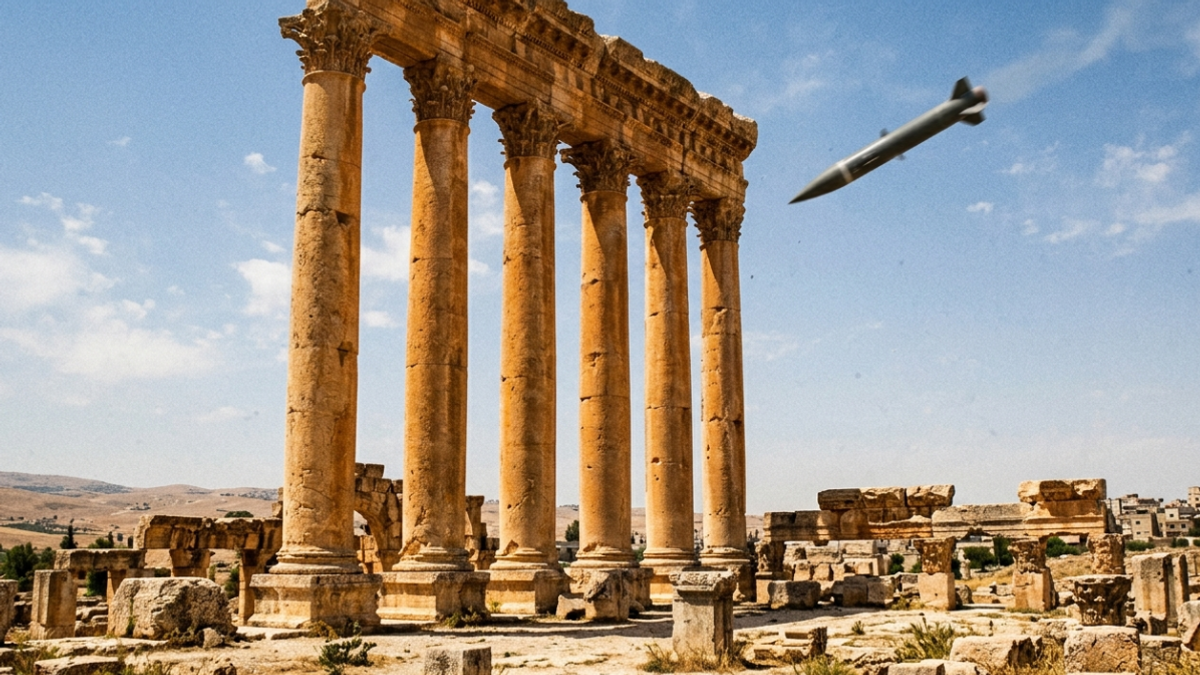
4. Cultural Warfare: Embedding and Destroying Historical Heritage Lebanon's archaeological legacy spans Phoenician, Roman, Ottoman, and Crusader eras. To prevent its command centers from being targeted, Hezbollah routinely positions its bunkers, supply routes, and launch pads within the immediate vicinity of these globally protected monuments.
• Baalbek and Tyre under Siege: Despite UNESCO granting enhanced Blue Shield protections to major Lebanese cultural sites, Hezbollah has consistently operated within historical epicenters. In Baalbek, the placement of logistics cells near historical structures has exposed the Ottoman-era Manshiyeh house and the 150-year-old Hotel Palmyra to severe collateral damage. Similarly, in Tyre’s ancient maritime ruins, the group's insistence on using dense architectural zones for concealment has put irreplaceable heritage at risk of structural collapse.
• Qal'at al-Shqeef (Beaufort Castle): Perched 800 meters above sea level on a sheer cliff overlooking the Litani River, Beaufort Castle is a textbook example of tactical weaponization. Hezbollah inherited and vastly expanded the subterranean fortification of this medieval citadel, utilizing its natural grottos, rock-cut rooms, and ancient thick-walled chambers to house forward observation points and secure weapon storage completely shielded from modern aerial bombardment. By using the castle’s immediate perimeter as a staging ground, the militia gambled that the site's historical value would restrict enemy rules of engagement.
• Urban Core Demolition: In historic souks like the Ottoman-era market in Nabatieh and the centuries-old center of Bint Jbeil, Hezbollah utilized ancient subterranean pathways and tightly packed historic homes to embed its combat command centers. This tactical choice has effectively turned Lebanon's historical identity into an auxiliary shield for its rocket infrastructure.
The Structural Conclusion A non-state actor that uses ambulances to ferry mortar shells, hospitals to cache weapons, national dams as geopolitical leverage, and ancient fortresses to shield command centers is not defending a state; it is actively consuming it.
The permanent eradication of this threat requires moving past treating these incidents as isolated infractions. They must be viewed as a single, coordinated strategy of human and structural shielding that can only be broken when the state asserts an absolute, non-negotiable monopoly over every square inch of public and private infrastructure.
For a precise visual record of how these tactics are uncovered in the field, you can watch https://www.youtube.com/shorts/H265Z7cdVkk "IDF Discovers Weapons Hidden in Hezbollah Ambulance", which provides direct footage of military hardware concealed inside medical transport assets.