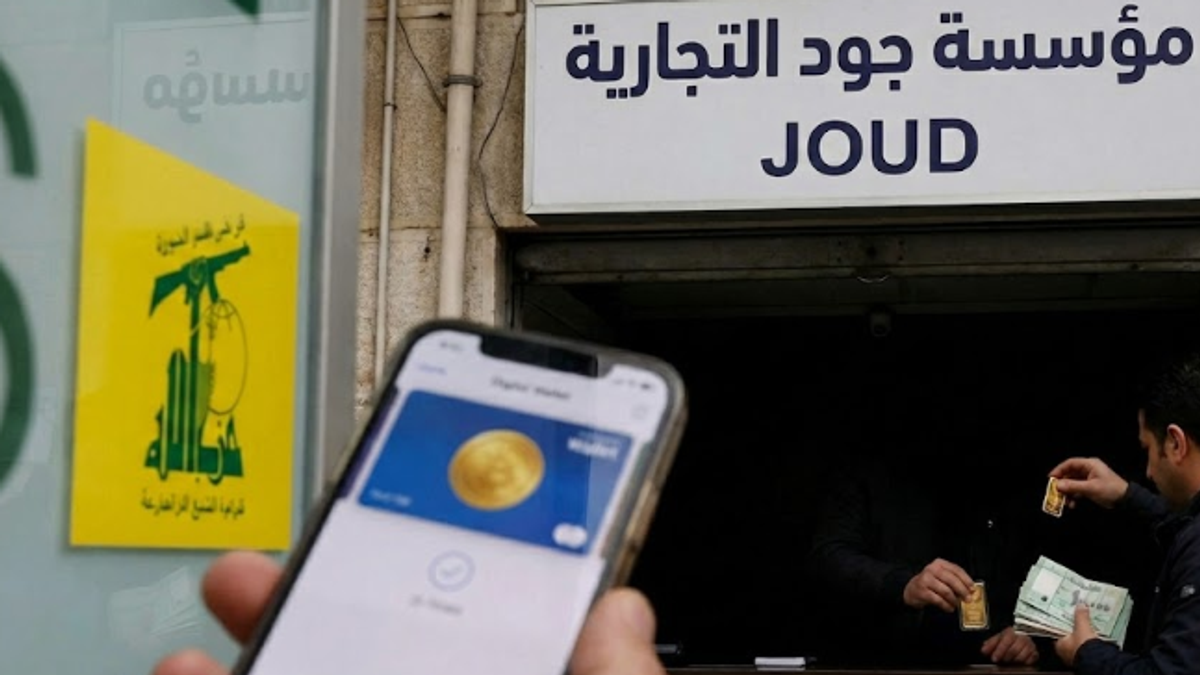
The July 2025 Central Bank (BDL) Directive—which prohibits dealings with unlicensed financial institutions—is the first step in a high-stakes war for Lebanon's economic survival. For U.S. policymakers, the stakes are clear: Lebanon’s unregulated “cash economy” has become the primary lungs for Iranian regional expansion and the $10 billion global Captagon trade. To protect the integrity of the U.S. dollar and Mediterranean stability, Washington must lead the effort to dismantle Hezbollah’s new, adaptive financial architecture.
I. The Mutation: From Al-Qard Al-Hassan to “Joud”
As international pressure mounts on the sanctioned Al-Qard Al-Hassan (AQAH), Hezbollah has launched a sophisticated successor: the “Joud” Association.
The Regulatory Loophole: Joud operates as a “commercial business” rather than a financial institution. By focusing on the buying and selling of gold on installments, it intentionally bypasses BDL banking oversight.
The Objective: Joud is designed to absorb AQAH’s hundreds of thousands of clients, ensuring the militia maintains its “parallel state” financial ecosystem while appearing—on paper—to be a regular retail operation.
II. The Gold Standard of Terror
With gold prices hitting record highs in 2025 (surpassing $4,000/oz), Hezbollah has shifted its primary value store to physical bullion.
Sanctions Immunity: Gold is the ultimate “dark asset.” It cannot be frozen via SWIFT or tracked by the U.S. Treasury.
The Vaults: Intelligence indicates that Hezbollah is aggressively liquidating cash into gold bars, tethering the wealth of the Lebanese Shiite community to a physical asset class controlled entirely by the militia.
U.S. Interest: This “Gold-Backed Shadow State” allows the IRGC to continue funding operations despite maximum-pressure sanctions.
III. Weaponizing Digital Banking: The Whish/OMT Breach
The pivot to digital platforms like Whish Money and OMT has created a new frontier for sanctions evasion.
The Fragmentation Tactic: As reported by the Financial Times (Nov 2025), Hezbollah-affiliated charities like the Martyrs Foundation and Al-Imdad use these platforms to receive millions in fragmented donations.
“Clean” Names: By utilizing thousands of individual digital wallets registered to “clean” names with no documented ties to the party, the militia bypasses automated compliance systems designed to flag suspicious organizational transfers.
The Risk to the Formal Sector: Failure to audit these platforms risks a “Contagion Effect,” where the entire Lebanese legitimate financial sector is blacklisted due to its use as a transit point for terror funds.
IV. The Intelligence Failure: “Unit 900” Infiltration
Enforcing the BDL’s July 2025 mandate is currently impossible because of Unit 900—Hezbollah’s internal security and counter-intelligence division.
The Breach: Unit 900 has successfully infiltrated the Special Investigation Commission (SIC) and the Lebanese Ministry of Finance. These operatives provide real-time warnings to Hezbollah’s “Finance Team” regarding pending U.S. Treasury actions or BDL audits.
The Threat to U.S. Interests: If the very people tasked with oversight are reporting to the militia, U.S. taxpayer support for Lebanese financial stability is effectively a subsidy for Hezbollah’s intelligence apparatus.
V. Policy Recommendations: A Hard-Nosed U.S. Mandate
The U.S. must abandon the policy of “gentle pressure” and adopt a Transactional Mandate for 2026:
Direct Sanctions on “Joud”: Immediately designate the Joud Association and its board of directors under E.O. 13224.
Audit the Gatekeepers: Condition all U.S. support for the BDL and the IMF recovery package on a full, independent security audit of the Special Investigation Commission to purge Unit 900 nodes.
Secondary Sanctions on Digital Platforms: Issue a final warning to digital wallet providers (Whish, OMT) that failure to implement AI-driven “Look-Through” compliance will result in their loss of access to the U.S. dollar-clearing system.
Gold Interdiction: Support the Lebanese Armed Forces (LAF) in seizing unlicensed gold vaults and shutting down the cross-border gold-for-Captagon smuggling routes to Syria.
Conclusion
Financial sovereignty is not a choice; it is a prerequisite for statehood. As long as Hezbollah operates a parallel, gold-backed economy, Lebanon will remain a failed state and a permanent threat to U.S. national security.