
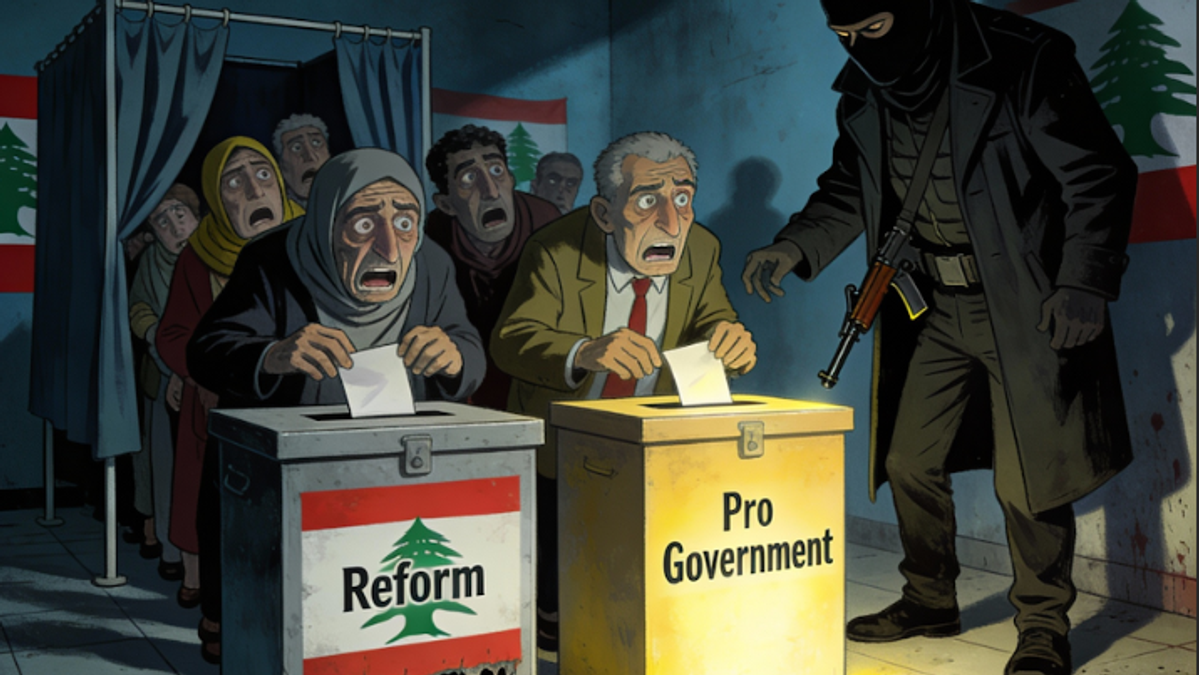
It is clear to everyone by now that the Taif Agreement that put an end to the war in 1989 introduced a constitutional framework that could have been solid, had it not remained just ink on paper. Instead, the post-war period solidified sectarian divisions in the political sphere, facilitated the rise of influential militias and gave rise to a hybrid system of security governance; not to mention foreign involvement: the presence of Syrian troops until 2005, followed by Iran’s more subtle but deeply entrenched influence that many Lebanese still view as a form of occupation.
A country emerging from a civil war with the declared goal of ending sectarianism therefore ended up doing nothing. All of this is to say that post-war Lebanon, despite the Taif Agreement, never became a genuine democracy: it is a procedural democracy on paper, but an autocracy in practice. A very clear example of this is the country’s electoral system: although general elections have been held regularly, they have consistently been preordained and not truly representative of the will of the people.
The next parliamentary elections, scheduled for May 2026 to elect all 128 members of Parliament, are already underway, but as long as they are held in this current political landscape, they will follow the same autocratic formula as the previous ones. There are three main reasons for this:
1. Hezbollah’s arms Can a democracy exist when one political party holds arms, assassinates opponents, intimidates voters and crushes rival campaigns. No democracy anywhere in the world can coexist with a state in which sovereignty is subverted.
2. An electoral law designed to keep the status quo Lebanon’s electoral law has been tailored to maintain an incumbent cartel in power. It has been carefully calibrated by governing parties, who function in a cartel-like manner, to guarantee the reelection of communitarian leaders and their MPs. This electoral law is a hybrid system combining proportional representation and preferential voting, implemented alongside gerrymandering ordered along confessional lines. What emerges from this is an electoral map that is, at its core, dysfunctional. On this map, votes are not weighed equally within districts and elected MPs do not represent the same number of voters. Representation is even unequal among voters of the same confession.
Let’s take an example: in Tripoli, there are approximately 71,000 Sunni voters per Sunni seat, while in the Bekaa there are only about 23,000 Sunni voters per Sunni seat.
The electoral threshold required for a list to win a seat is also excessively high. While most countries using proportional representation apply a threshold below 5%, Lebanon’s threshold ranges from 7.7% to up to 20% depending on the district.
A key example of this is the Free Patriotic Movement, holding 13% of parliamentary seats despite obtaining only 7% of the national vote. High thresholds also generate many wasted votes. In the last elections, approximately 40% of valid votes in the North and the South alike were cast for opposition lists that failed to make it to Parliament.
Where then, might we ask, is the supposed proportionality? The preferential voting system skews things even more. Voters must choose both an electoral list and a preferred candidate on that list.
In Lebanon’s confessional system, this incites candidates to compete as individuals for confessional seats rather than as part of a unified team presenting a common political vision. Confessional quotas can also prevent highly popular candidates from winning seats. For example, a Greek Orthodox candidate in Tripoli secured a seat with only 79 preferential votes, while a competing candidate on another list received more than 2,000 preferential votes and lost.
Equally revealing is what the electoral law deliberately omits: the political rights of the Lebanese diaspora. Millions of Lebanese living abroad—many forced to emigrate by war, corruption, and economic collapse—are denied full and equal participation in elections. Their voting rights are restricted, administratively constrained, and stripped of proportional representation, rendering their inclusion largely symbolic. This exclusion is not accidental. The diaspora is less dependent on clientelist networks and more likely to vote against the ruling cartel. By marginalizing expatriate voters, the electoral system further insulates incumbents from accountability and further undermines any claim to democratic legitimacy.
3. The electoral campaign cycle: not fair, not equal, not transparent Since 1990, state resources have gradually fallen under the monopolistic control of a small group of governing parties, transforming Lebanon’s political system into a party-cartel system. Clientelism is deeply embedded in this dysfunctional political system: the ruling parties have successfully managed to stay in power through patronage distributed via public institutions. Social welfare services such as education, healthcare, employment and basic infrastructure are allocated based on electoral loyalty.
With no democratic accountability whatsoever. The public sector is also severely overinflated as it employs more than 300,000 people. The overwhelming majority are partisan applicants who must vote for the ruling parties to keep their jobs. Not to mention their family members who are often mobilized in the same direction. Control of mainstream media also manipulates the electoral playing field. Political parties own their own television channels and dominate major media outlets. Access to media for opposition candidates is spectacularly expensive; in the last elections, an average of $20,000 was required for just 15 to 20 minutes of media exposure on major TV channels.
Voter intimidation and vote-buying are systemic. Polling stations are extremely numerous, with each station serving only 100–200 voters, often from the same families.
This makes it easy for party delegates to guess who is voting for them and to apply pressure accordingly. The delegate system itself gives these oligarchic parties an easy way to buy votes within their district, ensuring they meet the minimum threshold required. For example, in the Metn district, where I personally ran as an opposition candidate in 2018, there were 360 polling stations serving 183,441 voters. Eight MPs are elected in this district, so a list needs roughly 12,000 votes to secure at least one seat. Each candidate is allowed 360 delegates, one per polling station, making it possible to reach the threshold without any real campaigning.
Unless Lebanon reforms the electoral law to make representation truly equal, elections will keep serving the ruling elite instead of the people. These structural issues must be addressed before we can even talk about holding new elections; until then, Lebanon will remain trapped in a system that calls itself a democracy while denying citizens any real power.