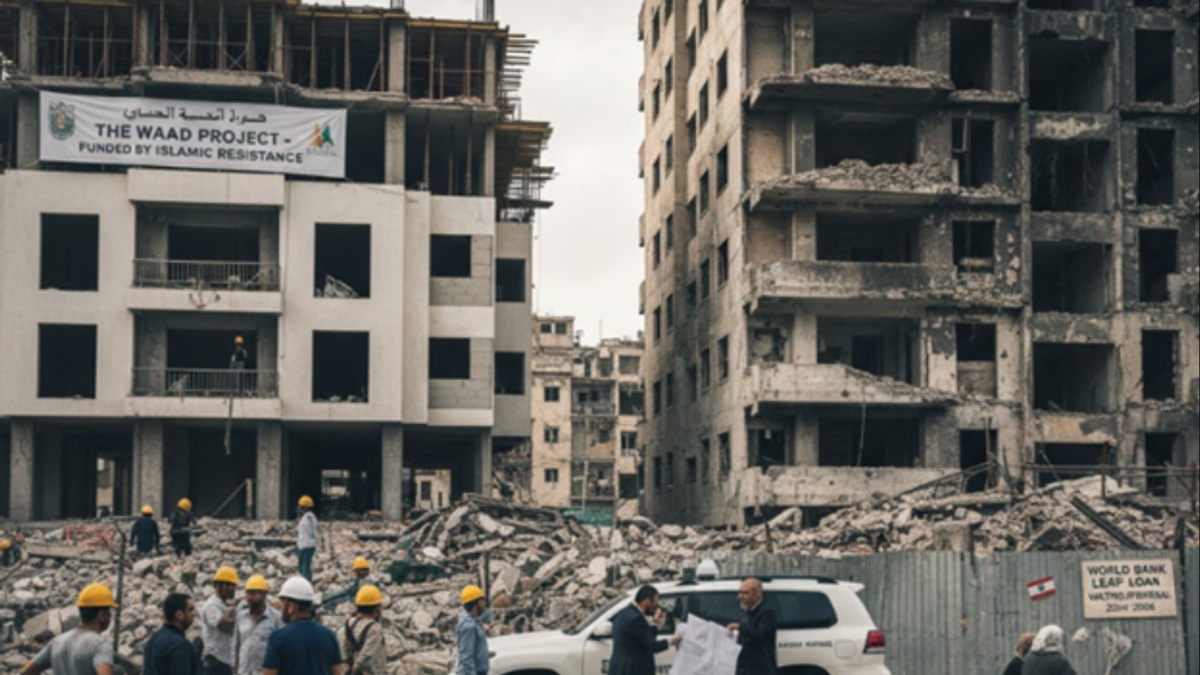
The World Bank loan is not a "bridge to recovery"; it is a bridge to nowhere. Every dollar that enters the current Lebanese institutional framework is a dollar that Hezbollah does not have to spend on its own base, effectively freeing up its "Gold Fortress" reserves for rearmament and the "Silicon Siege."
Facts:
By February 2026, the "spectacle" of international aid has become the most effective tool in Hezbollah’s arsenal. While the Lebanese government touts the $250 million World Bank "LEAP" loan signed by Finance Minister Yassin Jaber as a breakthrough, the reality is a hostage situation: international taxpayers are unknowingly subsidizing the militia’s parallel state.
I. The $3 Billion Shadow Budget
While the Lebanese state struggles to unlock the first tranche of its $250 million loan—a sum representing less than 3% of the $11 billion in total reconstruction needs—Hezbollah has already deployed its own $3 billion "Waad Project" and Jihad al-Bina infrastructure.
• Speed as Sovereignty: By clearing 90% of the rubble in the Dahiyeh and the Beqaa before the state even formed a committee, the militia has established a "First Responder" legitimacy.
• The Iranian Conduit: This $3 billion is not coming from the BDL. It is a direct injection of Iranian capital and private donations moved through the "Gold Fortress" and physical cash transfers, bypassing every AML/CFT (Anti-Money Laundering) control the World Bank has attempted to implement.
II. The Ministry of Public Works: A Militia Subsidiary
The World Bank’s framework relies on the Ministry of Public Works and Transport for execution. However, in 2026, this ministry remains a deep-seated node for Unit 900.
• The Vetting Gap: While the World Bank employs "international lender's engineering firms" for due diligence, the actual ground-level contractors are often shell companies like Meamar for Engineering Development, a Jihad al-Bina front.
• Data Hostages: Hezbollah’s "Social Unit" holds the primary surveys of damaged homes. For a Lebanese citizen to receive state aid, they must often first be "certified" by the militia’s local representatives, forcing the state to use Hezbollah’s databases to distribute international funds.
III. The "Southern Exclusion" Strategy
The most insidious element of the 2026 reconstruction landscape is the deliberate exclusion of border villages from the World Bank’s "LEAP" priorities.
• Forced Dependency: Because international funds are restricted from areas where "militia infrastructure" might still exist, residents in the South are left with only one option: Hezbollah’s compensation.
• The Ransom: By ensuring the state cannot rebuild the South, Hezbollah maintains a captive population. The "reconstruction" becomes a permanent lease on the loyalty of the border villages, paid for by the absence of state competition.
IV. The 2026 Budget Kill-Switch
As of February 2026, Hezbollah and the Amal Movement have issued a clear ultimatum: No reconstruction clause, no national budget. By demanding that the state fund "compensation" for destroyed homes without international oversight, the "Resistance Duo" is attempting to force the Lebanese Central Bank to print money to fund their social base. If the government refuses, the militia will trigger a total legislative collapse, once again proving that in Lebanon, "reform" is a secondary priority to the militia’s survival.