
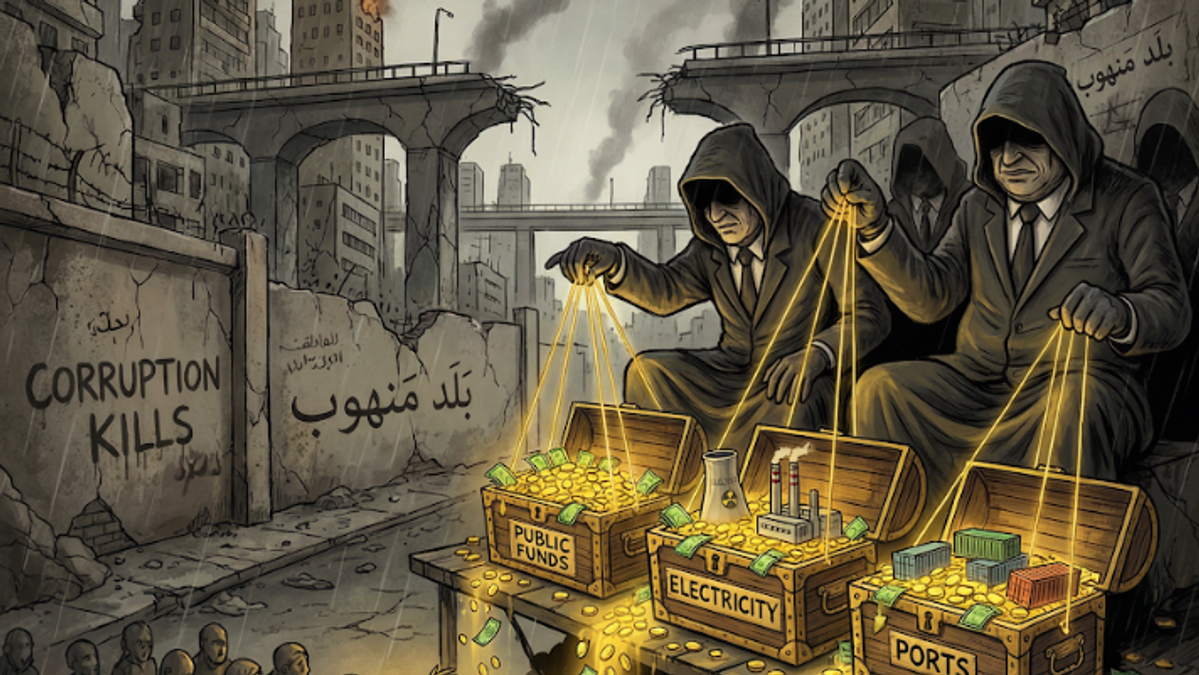
In Lebanon, saying there is governmental corruption at all levels requires no proof. Every citizen knows it. Every adult lives it. Millions voiced it during the 2019 uprising, demanding accountability.
The international community acknowledges that “Lebanon is corrupt,” but largely in abstract terms. Transparency International ranks 180 countries by perceived public-sector corruption; in 2024, Lebanon placed 154th—among the world’s bottom 25. The World Bank and the IMF regularly call for reforms.
What remains insufficiently addressed, or deliberately ignored, are the concrete and long-standing corrupt practices of Lebanon’s political class: the same leaders who have dominated public life for decades while enriching themselves, their families, and their networks at public expense. In Lebanon, petty corruption at the bottom is a direct consequence of entrenched grand corruption at the top.
It is high time to aim at the top.
Asset recovery—the identification, tracing, freezing, seizure, and return of assets stolen by public officials and transferred abroad—has become a global priority. The central international legal instrument is the United Nations Convention against Corruption (UNCAC), which establishes a framework for inter-state cooperation on asset recovery.
Under UNCAC, the World Bank launched the STAR Initiative, and many countries have enacted laws allowing the precautionary freezing of assets owned by politically exposed foreign persons, pending judicial proceedings. States such as the United States, Switzerland, and the United Kingdom have already established precedents by freezing assets of foreign corrupt officials.
UNCAC obliges signatory states to provide mutual legal assistance in gathering and transferring evidence, and to support tracing, freezing, seizure, and confiscation of corruption proceeds. Lebanon, a signatory since 2008, is therefore legally bound—and nationally obligated—to seek international judicial cooperation to recover stolen public funds.
Despite repeated promises, no Lebanese government has taken decisive action.
On October 21, 2019, the Lebanese Judges Association formally requested the Central Bank—specifically its Special Investigation Committee—to impose an immediate precautionary freeze on the accounts of all public officials and their associates, pending investigation. The request also recalled the Committee’s legal duty, under Lebanese Anti–Money Laundering Law (2015) and UNCAC, to coordinate with foreign counterparts regarding suspicious accounts held abroad by politically exposed persons.
Central Bank did not comply.
Conclusion
The Judges Association’s request provides a serious, credible, and legally sound foundation for a comprehensive asset recovery process—one that targets all political officials without exception or selectivity.
The current political moment is uniquely suited for such action. President Joseph Aoun and Prime Minister Nawaf Salam do not come from the traditional political establishment that oversaw decades of corruption and impunity. Precisely because they are outsiders to that system, they are better positioned than their predecessors to act.
Concerns over judicial independence are real but not insurmountable. They can be addressed through a treaty-level agreement with the United Nations establishing an independent international mechanism—combining Lebanese judges and prosecutors with international experts—to support investigations and prosecutions. The International Commission Against Impunity in Guatemala (CICIG) offers a proven precedent, having dismantled entrenched criminal networks and secured hundreds of convictions, including against senior officials.
Lebanon already has the necessary legal tools, access to international mechanisms, and a core of competent and courageous judges. Any serious action would also enjoy overwhelming popular support. After years of financial collapse and the destruction of life savings, the Lebanese people are not merely ready for accountability—they demand it.
What is missing is not capacity, legitimacy, or public backing. It is political will. It is courage.
The question is no longer whether Lebanon can pursue stolen asset recovery, but whether its leaders will choose to do so. Will this government seize this historic opportunity to restore trust, uphold accountability, and finally signal—at home and abroad—that the era of impunity has come to an end?
Time will tell.