
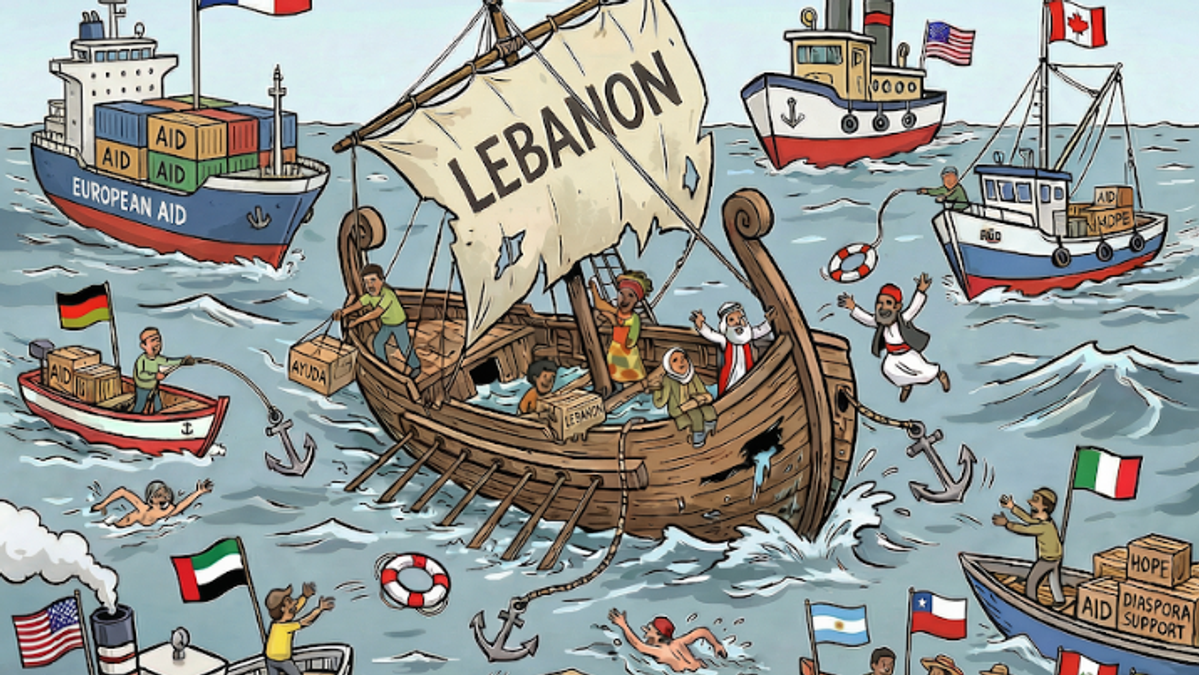
The 20 million strong Lebanese diaspora constitutes one of the most important yet underutilized resources in national political life. Beyond the borders of an exhausted state, millions of Lebanese live in stable democratic societies, having acquired political, economic, and institutional expertise that the governing structure inside Lebanon sorely lacks. This human capital, free from security pressures, clientelism, and sectarian constraints, today possesses a historic opportunity to play a pivotal role in redirecting Lebanon’s trajectory.
Experience has demonstrated that the current political system in Lebanon is incapable of generating self-reform. Networks of corruption intertwined with illegal arms have paralyzed the state, hollowed out its institutions, and tied national decision-making to regional axes that do not serve Lebanon’s interests. In this context, the Lebanese diaspora emerges as a force capable of breaking this cycle through not populist intervention, but by establishing an alternative political vision grounded in the concept of the modern state.
The diaspora’s primary advantage lies in its independence. It is not subject to fearmongering, the threat of weapons, or the calculations of daily survival. Moreover, the diaspora lives within a political environment that regards peace, a productive economy, and the rule of law as a fundamental pillar of stability. From this position, the diaspora can help reintroduce essential questions that have long been suppressed at home; questions like Lebanon’s place in the region, the viability of perpetual open conflict, and the limits of using force outside the framework of the state.
A rational approach to regional relations, including relations with Israel, is no longer a matter of intellectual maturity but a national necessity. States are measured by the interests of their peoples, not by slogans; peace should not be a concession so much as a sovereign tool to protect the economy and society. Likewise, reconnecting Lebanon with its natural depth in the Western world where its educational and financial institutions were forged is a fundamental condition for restoring international confidence and financial investment.
The role of the diaspora cannot be reduced, however, to just financial transfers or moral support, but rather to organizing itself as a political and intellectual pressure force: through media, research centers, lobbying efforts, and by supporting forces of change within Lebanon with clear programs rather than emotional rhetoric. It can also contribute to shaping a new national discourse that transcends the binary of “pro-resistance versus traitor,” and redefines patriotism as a commitment to the state, the law, and the public interest.
Recovering Lebanon does not begin with the removal of individuals, but with dismantling an ideological system built on corruption, fear, dependency, and the sanctification of weapons. It is precisely here that the Lebanese diaspora holds an irreplaceable role: to serve as a bridge between the experience of the modern state and the dream of the lost state, and to help move Lebanon from being an arena to becoming a state.
Lebanon will not rise through the efforts of those inside the country alone, nor through the external engagement alone, but through the convergence of internal will and diaspora awareness. When the diaspora transforms from a witness to "collapse” into a partner in the re-founding the nation, change becomes possible beyond just a slogan, but as a viable national project.
This is what we at the “American Lebanon Education Foundation” stands for . Let this sink in