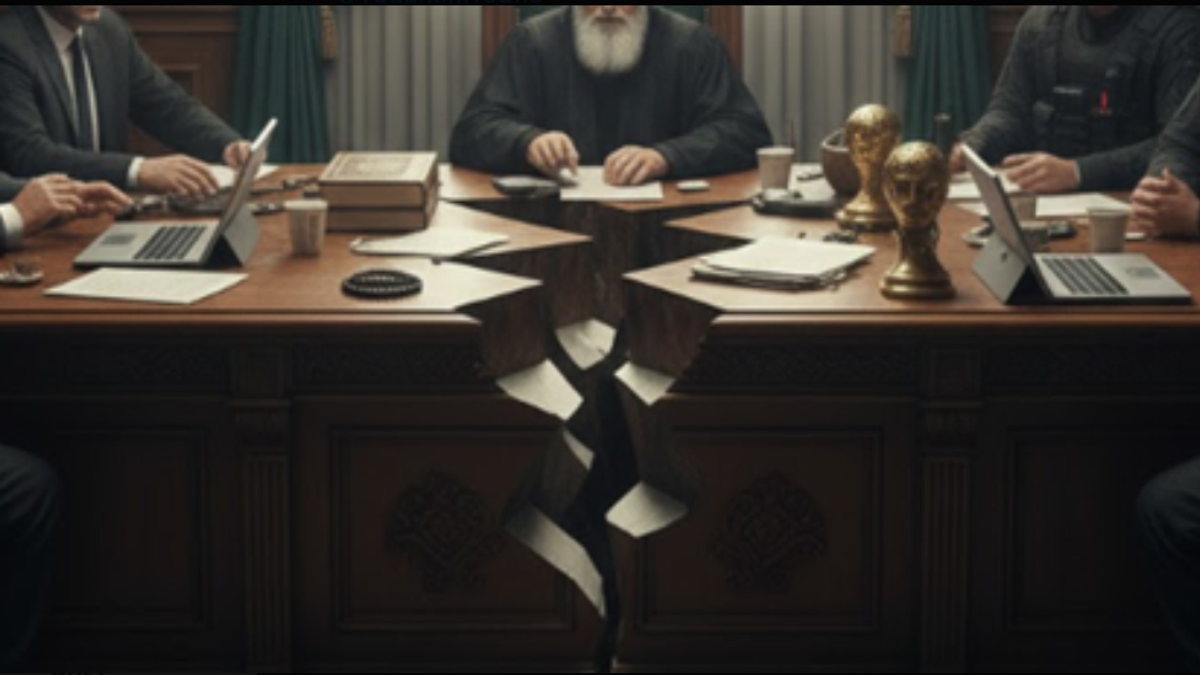
Hezbollah is no longer a unified "State within a State." It is a collection of warring departments held together by Iranian cash and a shared fear of the Lebanese Army's "Homeland Shield Plan." Naim Qassem is a leader on a deadline. If he cannot secure a "Political Shield" by May 2026, the Shura Council will likely move from words to daggers, and the "Resistance" may finally consume itself.
Facts:
By February 14, 2026, the monolithic image of Hezbollah has fractured. While Naim Qassem has officially occupied the role of Secretary-General since late 2024, his tenure is increasingly viewed not as a new era, but as a fragile regency. The "Spider Web" is tearing from within as the Shura Council—the militia's highest decision-making body—splits into two irreconcilable camps, each fighting for the soul of the "Resistance" in a post-Nasrallah Lebanon.
I. The "Regency" of the Bureaucrat
Naim Qassem, the perpetual deputy, was elevated by default following the 2024 decapitation of the militia’s top tier, including the presumed successor Hashem Safieddine. Qassem’s 2026 strategy has been one of Institutional Consolidation:
• The "Grey" Leadership: Unlike his predecessor, Qassem lacks the "Sayyid" charisma and the cult of personality required to unify the various factions. He has pivoted to a bureaucratic model, attempting to manage the militia like a corporate entity under siege.
• The Surge of the Political Bloc: Under Qassem, political figures like Mohammad Raad have seen their influence grow. This "Political Wing" argues for a tactical retreat—participating in the May 2026 elections and using the state as a shield to survive the "Silicon Siege."
II. The "Tehran Hardliners" and the "Renewal Current"
Opposing Qassem’s cautious bureaucracy is the "Radical Shura"—a faction of military commanders and younger clerics with direct, unfiltered ties to the IRGC’s Quds Force.
• The Disarmament Rift: The "Renewal Current" within the Shura Council quietly suggests that some form of "weapons integration" with the Lebanese State might be necessary to avoid total liquidation.
• The IRGC Mandate: In contrast, the Hardliners view any talk of disarmament as an existential betrayal. Intelligence suggests this faction, supported by high-level IRGC advisors in Beirut, has bypassed Qassem to coordinate directly with "Unit 1000" and "Unit 4400" to ensure the "Gold Fortress" remains independent of any political compromise.
III. The Ghost of Hashem Safieddine
The vacuum left by Safieddine—whose formal funeral was only held in February 2025—remains the Shura Council’s greatest wound. Safieddine was the bridge between the religious elite and the military apparatus. Without his "Black Turban" authority, the council has devolved into a series of "feudal" silos:
• The Military Silo: Operates autonomously north of the Litani, often ignoring Qassem’s "political" directives.
• The Financial Silo: Managed by the merchants of Joud SARL, who prioritize profit and rearmament over social welfare.
• The Security Silo: Controlled by Unit 900, which now acts as a pre-emptive purge mechanism against "soft" elements within the party.
IV. The May 2026 Ultimatum
The upcoming parliamentary elections represent the "Kill-Switch" for the current leadership. If the Hezbollah-Amal bloc loses its ability to paralyze the Lebanese Cabinet, the Shura Council Hardliners are expected to trigger a "Correctional Movement"—effectively a domestic coup within the party to replace Qassem with a more militant, Iranian-vetted figure, potentially from the IRGC-aligned "military cadre" that survived the 2024 purge.