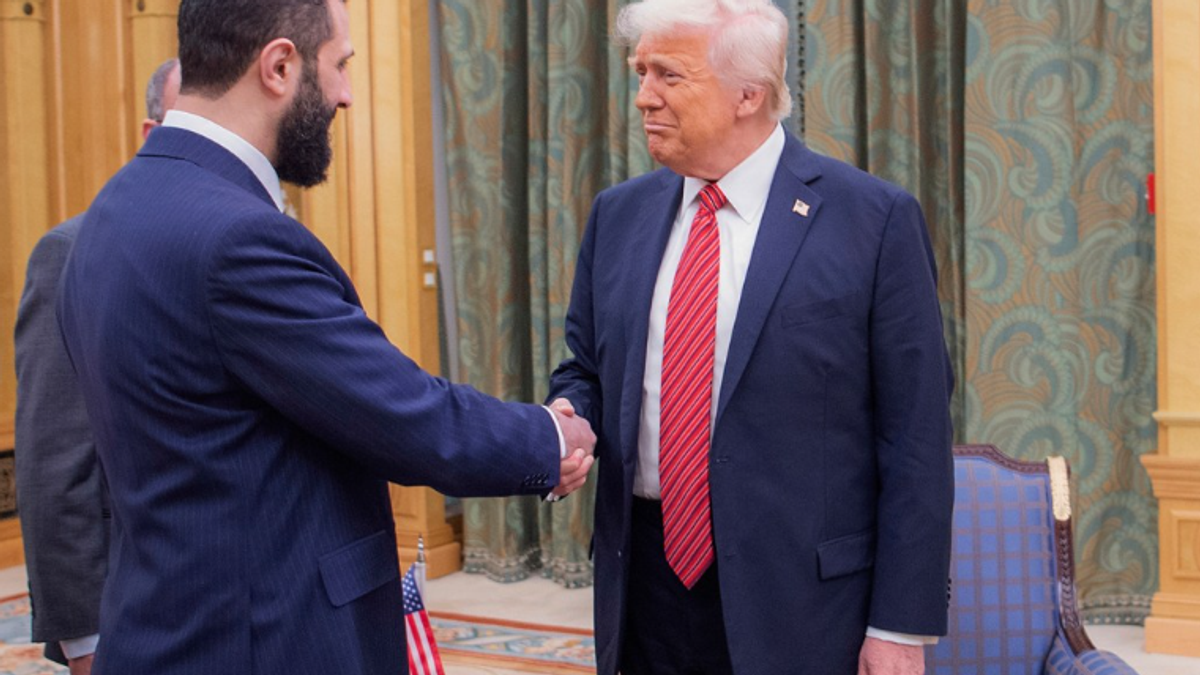
When the world gathers in New York for the annual United Nations General Assembly, the city becomes a stage for dialogue, diplomacy and global ambition. But this year, that stage is overshadowed by a deeply uncomfortable reality: Syria’s President Ahmad al-Sharaa — a man whose political and militant roots are tied to al Qaeda and its affiliates — will be walking the same streets that still bear the weight of Sept. 11, 2001.
I remember that day with painful clarity. At the time, I was the Washington bureau chief of a London-based Arabic daily, standing on the corner of 17th Street and Pennsylvania Avenue as chaos gripped the capital. Staff were rushing out of the Old Executive Office Building, terrified that another hijacked plane was headed toward the White House.
As an immigrant from Lebanon, I felt a deep sense of duty to my adopted country. That sense of service led me to help the Broadcasting Board of Governors establish Arabic-language radio and television channels, which I later managed for seven years as director of network news and executive vice president of the organization that ran them.
Those searing memories — the horror, the fear, the sense everything had changed — came flooding back when I learned Syria’s new president, a man once affiliated with al Qaeda, would be walking the streets of New York this month.
For President Trump, this moment is even more personal. New York is not just another American city to him; it is his city. It is where his towers stand, where his legacy was built and where the memory of 9/11 is an open wound — for the families of nearly 3,000 souls lost and for a nation that still mourns.
To see a man with Sharaa’s past standing in Manhattan, welcomed under the banner of diplomacy, is not just a question of foreign policy. It is a matter of moral clarity.
His history is well documented. As a young man, Sharaa joined al Qaeda in Iraq, rising through the ranks during the post-invasion insurgency. After his release from a U.S.-run prison there, he resurfaced in Syria as a leader of the Nusra Front, an al Qaeda affiliate that waged a brutal, sectarian war. He attempted to rebrand himself in 2016 by founding Hay’at Tahrir al-Sham, claiming independence from al Qaeda. Yet U.S. officials and counterterrorism experts have been clear: a change in name does not erase a legacy of extremism, violence and ideology rooted in hate.
For New Yorkers — survivors, families and first responders — this history is not abstract. It is deeply personal. It is the sound of sirens, the sight of smoke rising above the Hudson, the shock of a skyline changed forever and the names etched into memorials that line the city. The thought of Sharaa stepping onto American soil without a clear reckoning with that past is a wound reopened.
The Trump administration sees Sharaa’s presence at the UN as an opportunity — a chance to stabilize Syria, counter Iranian influence and claim a diplomatic win. But optics matter. Welcoming Sharaa to New York without a public acknowledgment of his past risks signaling that the United States is willing to look past a history of terror for the sake of political expediency. In the city that bore the brunt of al Qaeda’s savagery, that message lands like a betrayal.
If Sharaa wants to be seen as a legitimate head of state, there is one path forward. He must stand before the world and unequivocally denounce al Qaeda and its affiliates. He must declare, in plain and unambiguous language, that the attacks on the World Trade Center and the Pentagon were acts of barbaric terrorism. And he must state clearly, without qualification, that Osama bin Laden was a terrorist — not a hero, not a misunderstood figure, but the architect of mass murder.
President Trump, who knows the power of imagery better than most, faces a moral test. Silence or vague half-measures would make this visit not a symbol of progress but a painful reminder that some wounds never heal.
If Sharaa fails to publicly acknowledge that 9/11 was an unforgivable act of terror, his presence in New York is not a gesture of hope — it is a stain on the city that bore the heaviest cost. This isn’t just about geopolitics or strategy; it’s about the message sent to the families who lost loved ones, to the firefighters and police officers who ran into collapsing towers and to a city that will never forget.
If Trump truly loves New York as he says — if this city truly is the beating heart of his story — then he must insist Sharaa confront his past publicly and without ambiguity.